Last updated May 15, 2026 with current false-decline data, refreshed AI detection-accuracy research, and a trust-led approach to protecting both margin and the customers you actually want to keep.
The conversation about fraud usually starts with money lost to bad actors. The more honest version starts somewhere else: with the legitimate customers your fraud defenses quietly turn away.
Four in ten shoppers reported a false payment decline in 2024, and many of them never came back to that retailer. Industry research shows the average payment decline rate runs close to 8% globally, with rules-based legacy systems producing false-positive rates of 10–20% on legitimate orders. The fraud you stop matters. The legitimate customer your defenses block matters more, because that customer doesn’t write you an angry email. They quietly buy from someone else.
This is the structural problem with how most ecommerce brands still think about fraud prevention. The instinct, after a fraud spike, is to tighten the rules for everyone. The result is a system that catches slightly more bad actors and significantly more good ones. The math rarely favors the brand.
Below is a clearer view of how fraud actually damages customer experience, the patterns to watch for in 2026, and how a trust-led approach lets you tighten on abuse without losing the loyal customers who keep coming back.
The Hidden Costs of Fraud (and Anti-Fraud Defenses) on Loyal Customers
The direct cost of fraud shows up on a finance dashboard. The indirect cost shows up in places that are harder to measure and often more expensive:
- False declines. Tighter fraud rules, deployed in response to a spike, tend to over-block borderline-but-legitimate orders. Foreign cards, high-value first-time buyers, mobile orders from unfamiliar locations. The customer experiences this as “you don’t trust me,” and that’s exactly the message they take.
- Delays and cancellations. When a fraud trend is moving fast and the response is manual, legitimate orders get held while the team investigates. Good customers wait, get nervous, and sometimes cancel.
- Reputational damage. Publicized fraud incidents (data breaches, account compromises, mass chargebacks) erode the trust your marketing team worked years to build. Edelman’s 2025 Trust Barometer found 71% of consumers now use brand trust as a “buy or boycott” factor in their purchase decisions.
- Price and policy reactions. Some brands respond to rising fraud by raising prices, tightening return windows, or restricting promotions. Each move pulls a lever that costs goodwill with legitimate customers in exchange for marginal fraud savings.
- Lost future revenue. Customers whose first transaction was blocked or delayed rarely come back to retry. Their lifetime value walks out the door silently.
- Eroded customer trust. Repeated incidents (theirs or yours) make shoppers cautious, leading to abandoned carts at the security step, lower repeat-purchase rates, and longer purchase consideration windows.
The thread connecting these costs is the same: fraud prevention designed primarily around stopping bad actors usually trains good customers to feel suspect. The pendulum swings too far, the friction breaks the experience, and the brand absorbs the damage on both sides of the transaction.
Eight Fraud Patterns Showing Up Most in 2026
Eight categories of fraud account for most of what brands are seeing right now. None are new individually, but the volume, sophistication, and AI-assisted scale have all climbed.
- Stolen credit card fraud. Unauthorized purchases using compromised card data, often paired with mismatched shipping addresses and unusual order patterns.
- Coupon and promo abuse. Manipulation of promotional codes through fake identities, multiple account creation, or scaled bot activity. Real revenue cost, often invisible until the marketing team notices CAC numbers don’t add up.
- Return fraud. Wardrobing, empty-box returns, decoy returns (counterfeit items returned in place of the original), and serial returners who exploit generous return windows. NRF’s 2025 Retail Returns Landscape report names 9% of all returns as fraudulent.
- Item-not-received (INR) fraud. Customer claims a delivered package never arrived, sometimes with photoshopped proof. The pattern often cascades — one viral TikTok showing “the easiest brand to get a free [item] from” generates hundreds of copycat claims within days.
- Card testing. Fraudsters validate stolen card data by running small charges on ecommerce sites, often pairing genuine billing details with disposable emails and shipping addresses. Mastercard’s research shows roughly a third of global ecommerce merchants face active card testing.
- Account takeover (ATO). Compromised customer accounts used to make purchases, leveraging stored payment data and trusted account history. TransUnion’s H1 2026 fraud trends report shows a 37% YoY increase in the ATO suspected digital fraud rate.
- Gift card fraud. Stolen gift card data (often acquired from breaches sold on the dark web or encrypted messaging apps) used to make online purchases.
- Reshipping scams. Stolen cards used to purchase goods sent to a third party (often a victim recruited through romance or fake-employment scams), then forwarded to the actual fraudster.
The defense that works against this whole list isn’t a tighter wall around checkout. It’s connected signal across the journey, so the patterns become visible before they cascade.
What Trust-Led Fraud Prevention Customer Experience Actually Looks Like
Three capabilities, working together, are what separate fraud programs that protect customer experience from those that quietly degrade it.
Upstream Decisioning Before the Order Is Created
The traditional model screens orders after they’re in the system. The better model intercepts at the gateway or upstream, so suspicious activity never becomes a legitimate-looking order in your fulfillment pipeline. Less to clean up, faster decisions, fewer good customers caught in the middle while the team investigates a fraud spike.
The result for the fraud prevention customer experience is invisibility. The trusted shopper never knows fraud screening happened. The bad actor gets blocked before the order infrastructure spins up. Operations gets time back.
AI Plus Human Expert Review for the Best Fraud Prevention Customer Experience
Pure AI tends to over-decline borderline orders, especially the foreign cards, high-value first-time buyers, and unusual-but-real customers who don’t fit the model’s idea of “normal.” Pure human review doesn’t scale. The strongest systems pair AI screening with expert analysts who handle the cases where merchant-specific context matters most.
The numbers behind this matter. Industry research puts modern AI fraud detection accuracy at 90–97% versus 60–75% for rules-based legacy systems, and false-positive rates have dropped from 10–20% to under 2%. Mastercard’s gen-AI work on compromised cards doubled detection rates and cut false declines by up to 200%. HSBC reduced false positives by 60% after deploying AI-driven dynamic risk assessment. These are the differences that move the customer experience needle, not just the fraud-rate needle.
Connected Signals Across the Full Journey
The patterns that hurt the most (coordinated abuse, repeat ATO, friendly-fraud cascades, refund manipulation) usually look isolated at the transaction level and only become visible when you connect signals across checkout, returns, claims, support, account behavior, and chargebacks. Most legacy tools see one moment at a time. Modern risk intelligence sees the whole relationship.
Practical Tips for Merchants on Fraud Prevention Customer Experience
- Audit your false-decline rate quarterly. If you don’t know what it is, that’s the first finding. Most brands underestimate by a wide margin.
- Tier your verification by risk and trust signal, not by blanket rule. Lighter checks for shoppers with clean history. Tighter for unfamiliar context. The blanket-rule approach is what causes the legitimate-customer damage.
- Set velocity checks. Limits on signups, password attempts, card retries, and order rate. Most automated abuse announces itself through velocity before it causes real damage.
- Use two-factor authentication on customer accounts by default. Microsoft and Google research shows 2FA blocks roughly 99.9% of automated account attacks.
- Monitor across surfaces, not just checkout. Returns, claims, support tickets, and account behavior all carry signal about coordinated abuse. Watching only checkout means missing the journey-level patterns where the most damaging fraud now lives.
- Choose a risk intelligence partner that embeds decisioning inside your existing tools (Shopify, your CX platform, returns platform, support system) rather than another dashboard nobody checks.
How Wyllo Helps Fraud Prevention Customer Experience
Wyllo, the CX-first risk intelligence platform, was built around exactly this premise: stop fraud upstream, keep trusted shoppers frictionless, and connect signals across the journey. Two products do the most work in the fraud-versus-CX conversation:
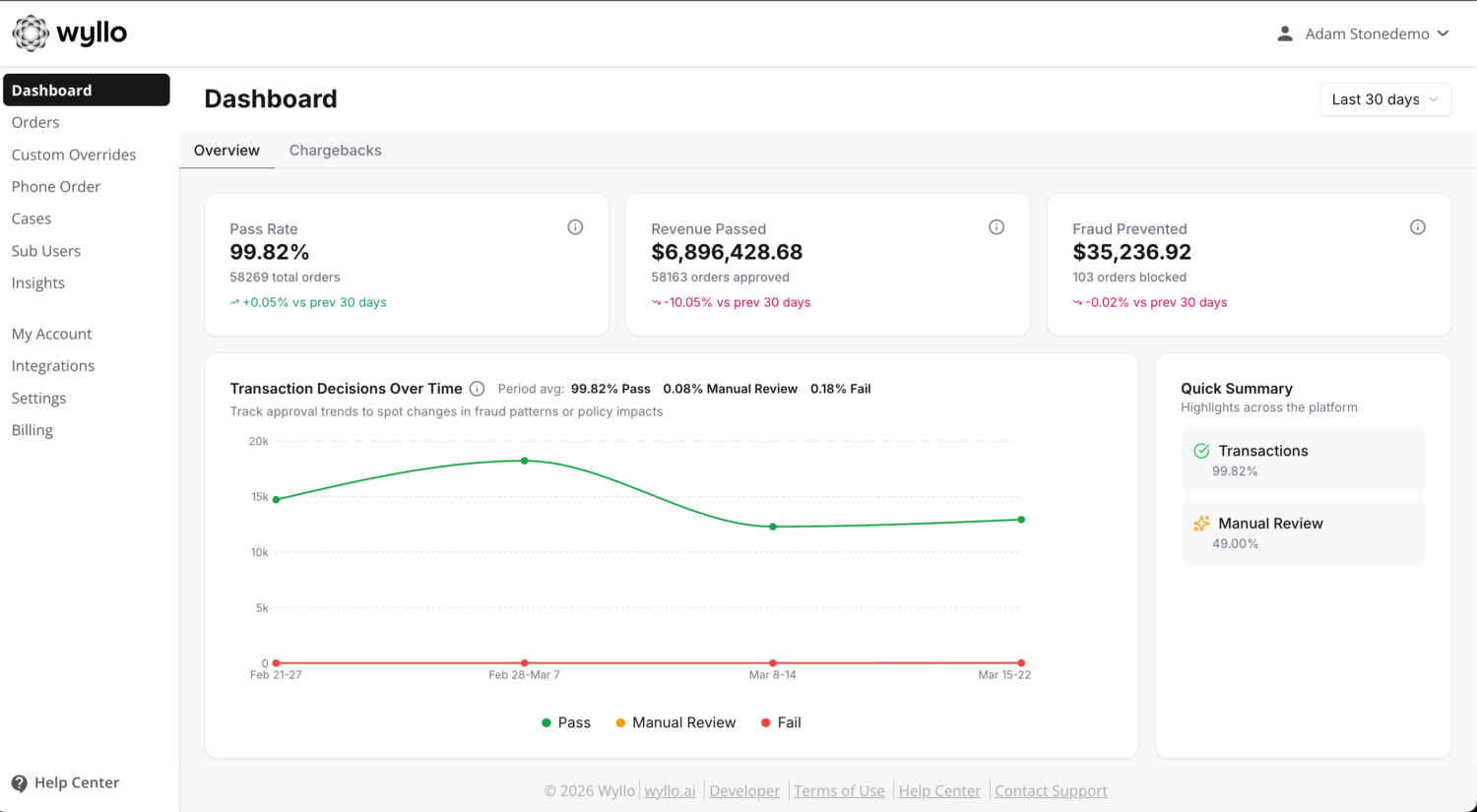
- Wyllo Payment Fraud Protection pairs AI-driven decisioning with human fraud experts who review the orders where merchant-specific context matters most. Higher approval rates on real customers. Stronger catch rates on coordinated abuse. Optional chargeback guarantee for predictable economics on residual loss.
- Wyllo Claim and Policy Abuse Prevention catches ATO, refund manipulation, coupon abuse, and policy exploitation upstream — before they cascade into refund cycles, chargebacks, and escalations.
For brands seeing the most damage from coordinated post-purchase abuse (the INR, return, and claim-fraud category that’s grown fastest), Wyllo Bot and Reseller Detection and Return Fraud and Abuse Prevention handle the connected patterns that traditional transaction-level fraud tools miss.
Precision over paranoia. Less reaction. More reason. Designed to think ahead, so your fraud defenses keep your customers’ experience clean instead of clean of customers.
Frequently Asked Questions
How does fraud actually impact the customer experience?
Direct fraud incidents (data breaches, account takeover, fake-site impersonation) damage customer trust. The less obvious impact comes from the fraud defenses themselves: false declines on legitimate orders, delays and cancellations during fraud spikes, tightened return policies, price increases to offset fraud cost, and the cumulative friction that pushes good customers to shop somewhere else. Four in ten shoppers reported a false payment decline in 2024, and many didn’t come back.
What is a false decline and why does it matter?
A false decline is a legitimate transaction blocked by a fraud system that incorrectly flags it as suspicious. The cost is double: lost revenue from the blocked order, and lost lifetime value from the customer who concludes you don’t trust them. Modern AI systems run false-positive rates under 2%; rules-based legacy systems often run 10–20%. The gap between the two is meaningful enough to change brand-level economics.
How can I prevent fraud without hurting good customers?
Move away from blanket rules toward differentiated, trust-led decisioning in your fraud prevention customer experience. Lighter checks for shoppers with clean history. Tighter for unfamiliar context. Pair AI screening with human expert review on borderline orders. Watch signals across the full journey (checkout, returns, claims, support, account behavior) rather than just the transaction. The brands seeing the strongest results are the ones treating trust as part of the customer experience, not a separate compliance function.
What is pre-gateway fraud prevention?
Pre-gateway fraud prevention intercepts suspicious activity before the order is created in your system. It’s the difference between catching fraud at the door and catching it after fulfillment has already begun processing. The customer experience benefit is invisibility: trusted shoppers complete checkout normally, suspicious activity is blocked before it becomes operational drag, and your team’s time goes to the cases that genuinely need human judgment.
How effective are AI-powered fraud detection systems?
Significantly more effective than rules-based legacy systems. Current industry research puts AI fraud detection accuracy at 90–97% versus 60–75% for rules-based systems, with false-positive rates dropping from 10–20% to under 2%. Mastercard’s gen-AI work on compromised cards doubled detection rates and cut false declines by up to 200%. HSBC reduced false positives by 60% with AI-driven dynamic risk assessment.
What types of fraud are most common in 2026?
The MRC’s 2026 Global eCommerce Payments and Fraud Report names refund and policy abuse the #1 ranked fraud threat, displacing payment fraud for the first time. ATO is rising fastest year over year. The other major patterns: stolen card fraud, coupon and promo abuse, return fraud, INR claims, card testing, gift card fraud, and reshipping scams. The eight patterns aren’t new individually; the volume and AI-assisted sophistication have changed materially.
Bringing It Together
Fraud prevention is no longer a back-office function. It’s a customer experience function with margin implications. The brands that win this decade will be the ones that stop treating the two as competing priorities and start running fraud and CX as one connected system. Stop bad actors upstream. Reduce friction for the customers you want. Use AI plus human expertise on the cases that need both. Watch signals across the whole relationship, not just the transaction.
Curious how a CX-first risk intelligence approach changes the math on your fraud line and your customer experience metrics? Start with Wyllo Payment Fraud Protection for the AI-plus-human-experts model, or explore the broader Wyllo platform for connected intelligence across the full customer journey.