How the claims process (item not received (INR), damaged on arrival, warranty) gets turned into a refund engine, and what it takes to tell a real claim from a manufactured one and claims fraud
Every merchant needs a way for customers to say “my order never came” or “it arrived broken.” Those claims processes exist because real problems happen: packages get lost, items get damaged in transit, products fail. But the same processes are an attractive target, because they often pay out on the customer’s word alone, and disputing an honest-looking claim risks a bad experience for a genuine buyer. That tension is exactly what claims fraud exploits. Refund and policy abuse, the broader family claims fraud belongs to, now ranks among the top loss drivers for digital merchants in the Merchant Risk Council’s 2025 Global eCommerce Payments and Fraud Report.
This guide defines claims fraud, breaks down its common forms, and explains how to separate legitimate claims from fraudulent ones without making honest customers prove their innocence.
What Is Claims Fraud?
Claims fraud is the abuse of post-purchase claims, such as item-not-received (INR), damaged-on-arrival, and warranty claims, to obtain refunds, replacements, or credits the shopper isn’t entitled to. The order was placed and paid legitimately; the fraud is in the claim that follows, asserting a problem that didn’t happen or was caused deliberately.
Because a share of claims are always genuine, claims fraud is less about catching obvious lies and more about recognizing patterns that a single honest-looking claim never reveals.
Common Types of Claims Fraud
Item-Not-Received (INR) Fraud
Claiming a delivered order never arrived to win a refund or replacement while keeping the product. Often paired with addresses or delivery situations that make confirmation hard, and repeated across orders by the same actor or linked accounts.
Damage and Defect Claims
Reporting that an item arrived broken or defective, sometimes with deliberately caused or pre-existing damage, to secure a refund while keeping the goods. A growing wrinkle is manipulated evidence: lightly altered or AI-generated photos of “damage” submitted to automated approval workflows.
Warranty and Guarantee Abuse
Filing claims under warranties or satisfaction guarantees for problems that don’t exist, or stacking claims across channels to extract multiple resolutions for one order.
Missing-Item and Partial-Order Claims
Asserting that part of an order was missing from the box to get a partial refund or a free replacement of items that were in fact delivered.
Why Claims Fraud Is Hard to Catch
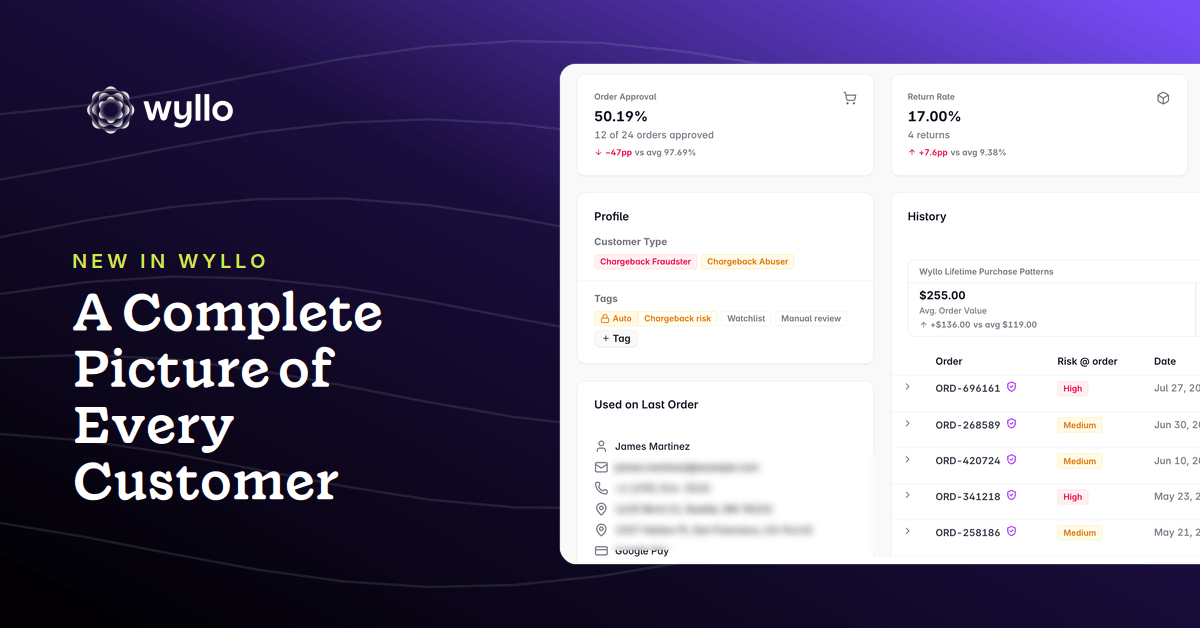
Claims fraud hides in legitimacy. Each claim, viewed alone, is plausible: packages really do go missing, items really do break. Reviewing one claim at a time, a support agent has little reason to doubt it, and refusing risks alienating a real customer. The fraud only becomes visible at the level of patterns: the same address behind repeated INR claims, an account whose claim rate dwarfs the norm, or linked accounts cycling the same script. That is why connected intelligence across orders, accounts, and delivery outcomes matters more than scrutiny of any single claim.
How to Reduce Claims Fraud
Score claims, don’t just process them. Apply risk signals to each claim using identity, order and delivery history, and prior claim behavior.
Connect the claim to everything around it. Link addresses, devices, payment methods, and accounts so repeat and coordinated claims surface even when each looks isolated.
Match verification to risk. Honest customers should get fast, generous resolution; higher-risk claims can warrant proof of delivery review, photo verification, or a closer look before payout.
Watch for manufactured evidence. As image manipulation gets easier, treat submitted photos as one signal among many rather than automatic proof.
How Wyllo Helps
Wyllo is the risk intelligence platform for commerce. Claims fraud is the clearest example of why intent beats event-by-event judgment: a single claim looks fine, the pattern across claims does not. Risk surfaces the claim; intent explains whether to trust it.
- Wyllo Claim and Policy Abuse Prevention spots INR, damage, and warranty claim abuse upstream, connecting claims to the identities and patterns behind them before they become refunds or disputes.
- Wyllo Return Fraud and Abuse Prevention extends the same intelligence to returns and refund behavior, including image manipulation detection.
- Wyllo CX Support puts risk context in front of agents so they can resolve generously for trusted customers and verify carefully where it’s warranted.
Less reaction. More reason.
Frequently Asked Questions
What is claims fraud in ecommerce?
Claims fraud is the abuse of post-purchase claims, such as item-not-received, damaged-on-arrival, and warranty claims, to win refunds, replacements, or credits the shopper isn’t entitled to. The purchase itself was legitimate; the fraud is in the claim that follows.
What is INR fraud?
INR stands for item not received. INR fraud is claiming that a delivered order never arrived in order to get a refund or replacement while keeping the product, often repeated by the same actor or across linked accounts.
How do merchants tell real claims from fraudulent ones?
Not by scrutinizing a single claim, since honest and fraudulent claims look alike one at a time. The difference shows up in patterns: repeat claims tied to the same address, accounts with abnormal claim rates, or linked accounts running the same script. Connecting signals across orders and accounts is what reveals intent.
Can AI-generated photos be used in claims fraud?
Yes. Lightly altered or AI-generated images of “damage” are increasingly submitted to automated claim approvals, which is why submitted evidence should be treated as one signal among many rather than automatic proof.
Bringing It Together
Claims processes exist to make customers whole when something genuinely goes wrong, and most claims are exactly that. Claims fraud exploits the benefit of the doubt those processes extend. Protecting them without punishing honest customers comes down to reading intent across the whole relationship rather than judging each claim in isolation.
Curious how connected intelligence would change which claims you pay without question and which you verify? Start with Wyllo Claim and Policy Abuse Prevention, or explore the Wyllo platform for connected intelligence across the full customer journey.