A spoke in Wyllo’s return abuse series: what the refund fraud service economy looks like from the merchant side, and how to prepare before peak season.
Professional refunders are for-hire operators who obtain fraudulent refunds on behalf of ordinary shoppers, taking a cut of the refund value in exchange. The shopper places a real order with a real identity; the refunder handles the fraud, filing the false item not received claim, working the support agent, or manipulating the shipment evidence. It is refund fraud run as a service, and it changes the merchant’s problem in a fundamental way: the person on the order is not the person running the scheme.
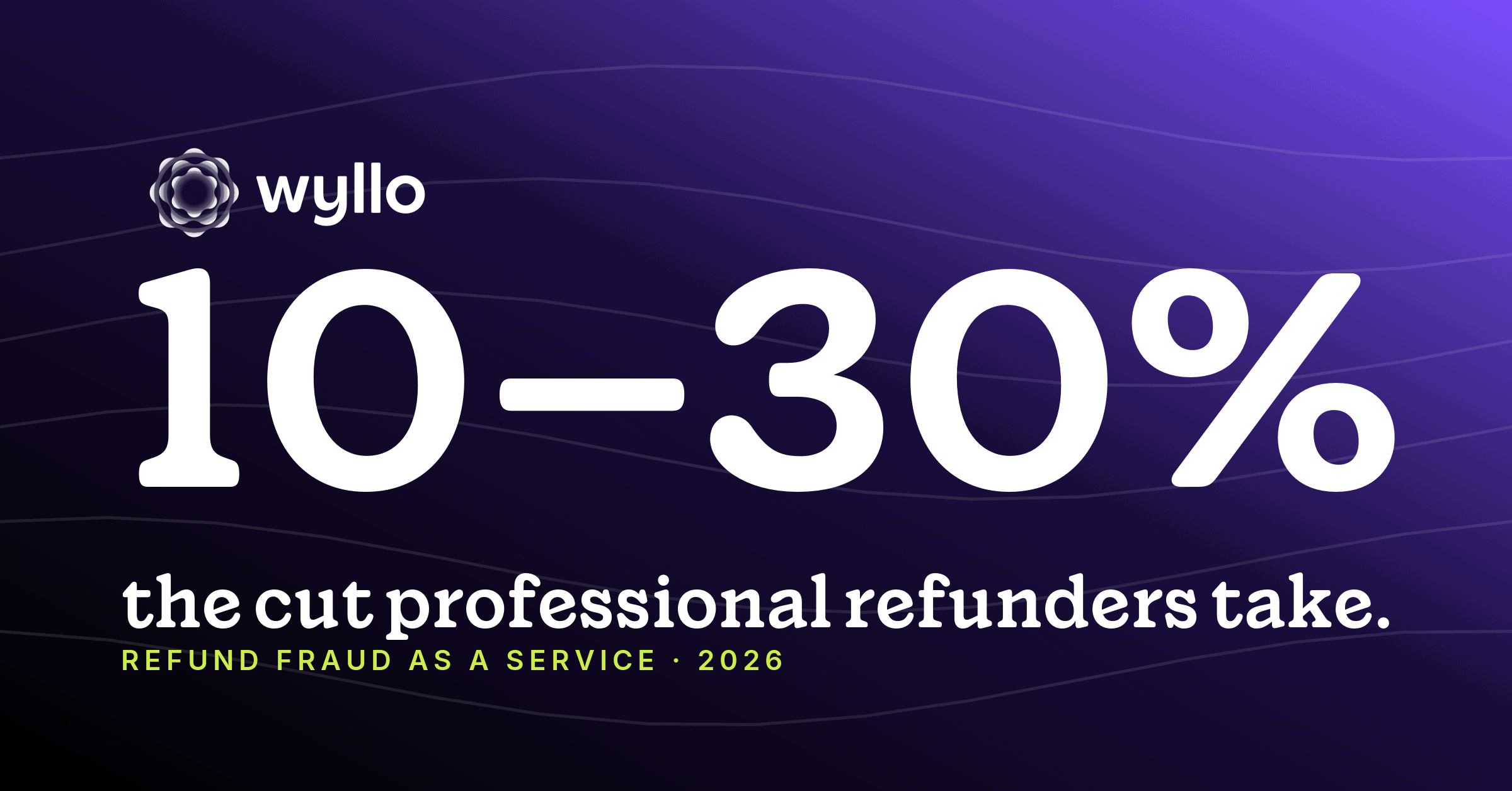
This is not a fringe behavior. Refund service operators openly advertise on messaging platforms and forums, and industry reporting on refund-as-a-service has counted over 1,600 such adverts, with operators typically charging 10 to 30% of the refund value. Law enforcement has taken notice: under the FBI’s Operation Chargeback, members of the “Noir’s Luxury Refunds” Telegram channel were sentenced to prison, per the Department of Justice, one of several organized refund groups the initiative has dismantled.
How Refund Fraud Services Work
The playbook, as documented in the DOJ’s account of the Noir organization, is service-industry professional. Operators socially engineer customer service representatives into issuing refunds, manipulate shipping labels so packages appear undelivered or misrouted, recruit customer service insiders at target retailers, and in some cases deploy tooling designed to slip past fraud prevention checks. The customer’s role is minimal: place the order, hand over the order details, receive the goods, and keep them while the refund lands.
That division of labor is what makes the model dangerous. Traditional abuse signals assume the abuser and the account holder are the same person learning by trial and error. A professional refunder brings rehearsed scripts, knowledge of specific merchants’ policy edges, and volume across many client accounts. The first claim from a given account can already be an expert claim.
What Merchants See
From the inside, service-assisted refund fraud looks like several of the warning signs of a return abuse problem arriving at once. New or dormant accounts file confident, well-formed claims with policy-perfect timing. Item not received and damage claims use strikingly similar language across unrelated customers. Refund-without-return requests spike in categories with high resale value. And support transcripts show claimants who know the escalation path better than the agents do.
The tell is uniformity. Organic abuse is idiosyncratic; a service produces patterns, the same phrasing, the same claim sequence, the same response to pushback, spread across accounts that share no obvious identity.
Preparing Before Peak
Peak season is the refund service industry’s high season too: volumes spike, carriers strain, support queues grow, and appeasement policies loosen exactly when scripted claims are hardest to spot. The preparation that pays off is mostly discipline you can build now. Tighten evidence capture on shipments, especially proof of delivery and signature on high-value orders. Trend claim language and claim rates per thousand orders so a scripted wave is visible in week one, not quarter three. Brief support teams on the social engineering patterns the DOJ documented, since agents are the schemes’ preferred entry point. And decide policy edges deliberately: refund-without-return thresholds, evidence requirements, and escalation rules set in advance beat improvised generosity under queue pressure.
How Wyllo Helps
Service-assisted fraud is built to look reasonable one event at a time, which is why event-level review misses it. Wyllo, the risk intelligence platform for commerce, applies Intent-Aware Decisioning to the pattern across accounts, claims, and support interactions:
- Wyllo Claim and Policy Abuse Prevention catches policy exploitation and support-channel abuse before it becomes a chargeback.
- Wyllo Return Fraud and Abuse Prevention connects INR and refund claims across identity and behavior, surfacing the uniformity that marks a service at work.
- Wyllo CX Support arms agents with risk signals in the conversation, so a rehearsed script meets an informed human instead of a reflex refund.
Growth doesn’t come from playing defense, and it doesn’t come from funding someone else’s business model either. The goal is a storefront where good customers feel trusted and professional claims stop being profitable.
Frequently Asked Questions
What is a professional refunder?
A professional refunder is a for-hire operator who obtains fraudulent refunds on a shopper’s behalf, typically for 10 to 30% of the refund value. The shopper places a legitimate order and keeps the goods; the refunder files the false claim and works the merchant’s support and dispute processes.
What was Operation Chargeback?
Operation Chargeback is an FBI initiative targeting organized refund fraud groups operating in the United States and internationally. It has led to prosecutions of groups including the “Noir’s Luxury Refunds” Telegram channel, whose members were sentenced to prison for schemes involving social engineering of support agents, manipulated shipping labels, and recruited insiders.
How can merchants detect service-assisted refund fraud?
Look for uniformity across unrelated accounts: similar claim language, identical claim sequences, policy-perfect timing, and confident first claims from new accounts. Customer-level and cross-account analysis surfaces these patterns; event-level review rarely does.
Should merchants treat all refund claims as suspect?
No. Most claims are honest, and blanket suspicion costs more in loyalty than the fraud costs in refunds. The proportionate response is evidence discipline on every order and added scrutiny only where the pattern earns it.
Bringing It Together
Refund fraud stopped being a solo activity. It has operators, pricing, marketing channels, and now, thanks to Operation Chargeback, case law. Merchants do not need to match that industrialization with paranoia; they need to match it with pattern-level judgment, because a service leaves fingerprints that no individual abuser does. Read the claims at the customer and cross-account level, prepare the policy edges before peak, and the economics that make refund services attractive start working in your favor instead.
Start with the seven warning signs of a return abuse problem to see where service-assisted claims surface first, and see how Wyllo Claim and Policy Abuse Prevention catches the pattern before it becomes a chargeback.