Originally published December 16, 2024. Last updated October 29, 2026 with Shopify’s current fraud analysis behavior and plan requirements, 2025 and 2026 false decline data from Datos Insights, PYMNTS Intelligence, LexisNexis Risk Solutions and Baymard, and a side by side view of where Shopify’s tool stops.
Shopify’s built-in fraud analysis is a useful first filter, and it is not a decision. It returns a recommendation of low, medium, or high risk on eligible credit card orders, and then leaves the call, and the chargeback liability, with you. For most merchants the practical question is not whether the tool works. It is how many of the orders it flags are real customers you are about to turn away.
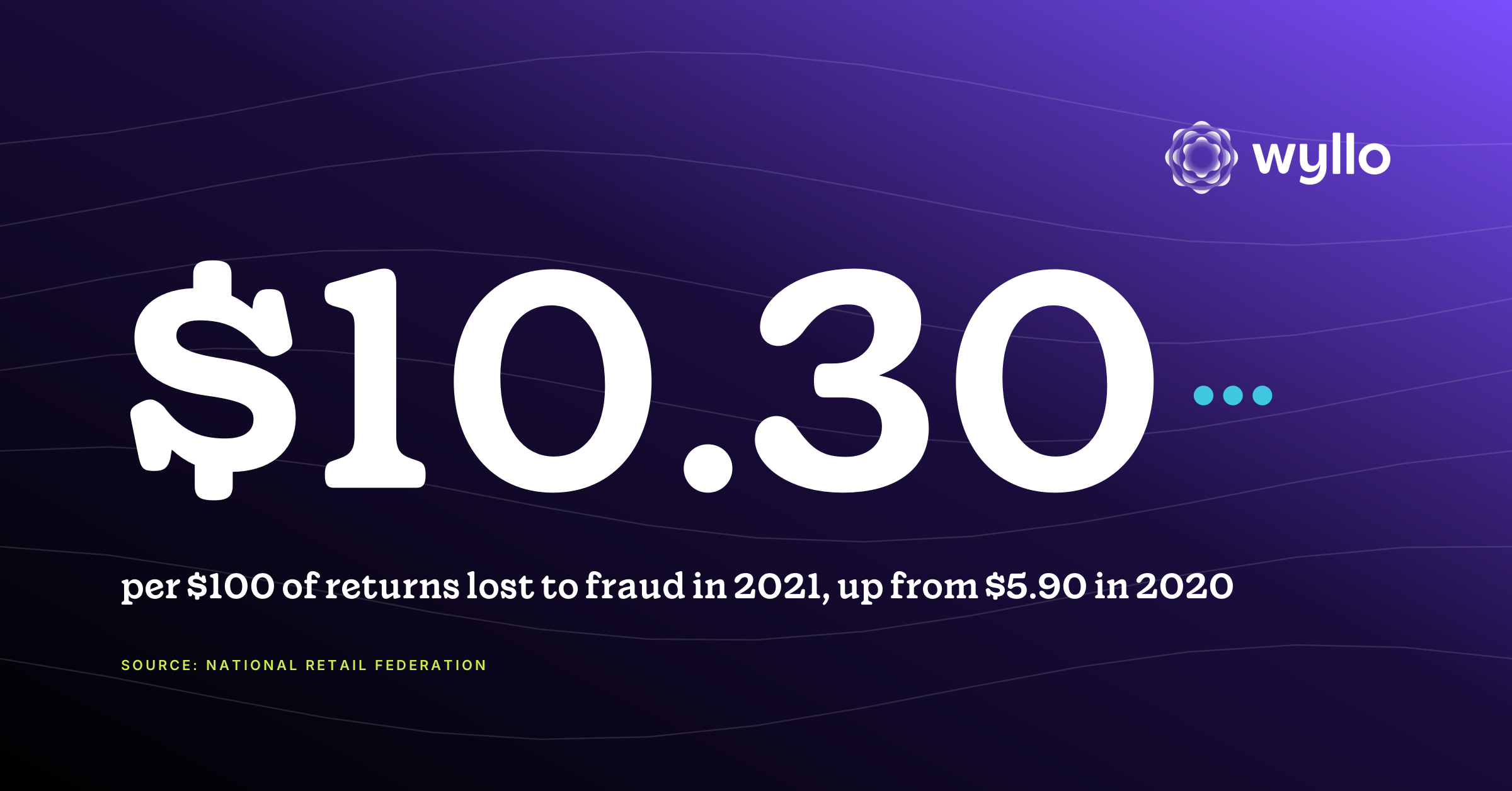
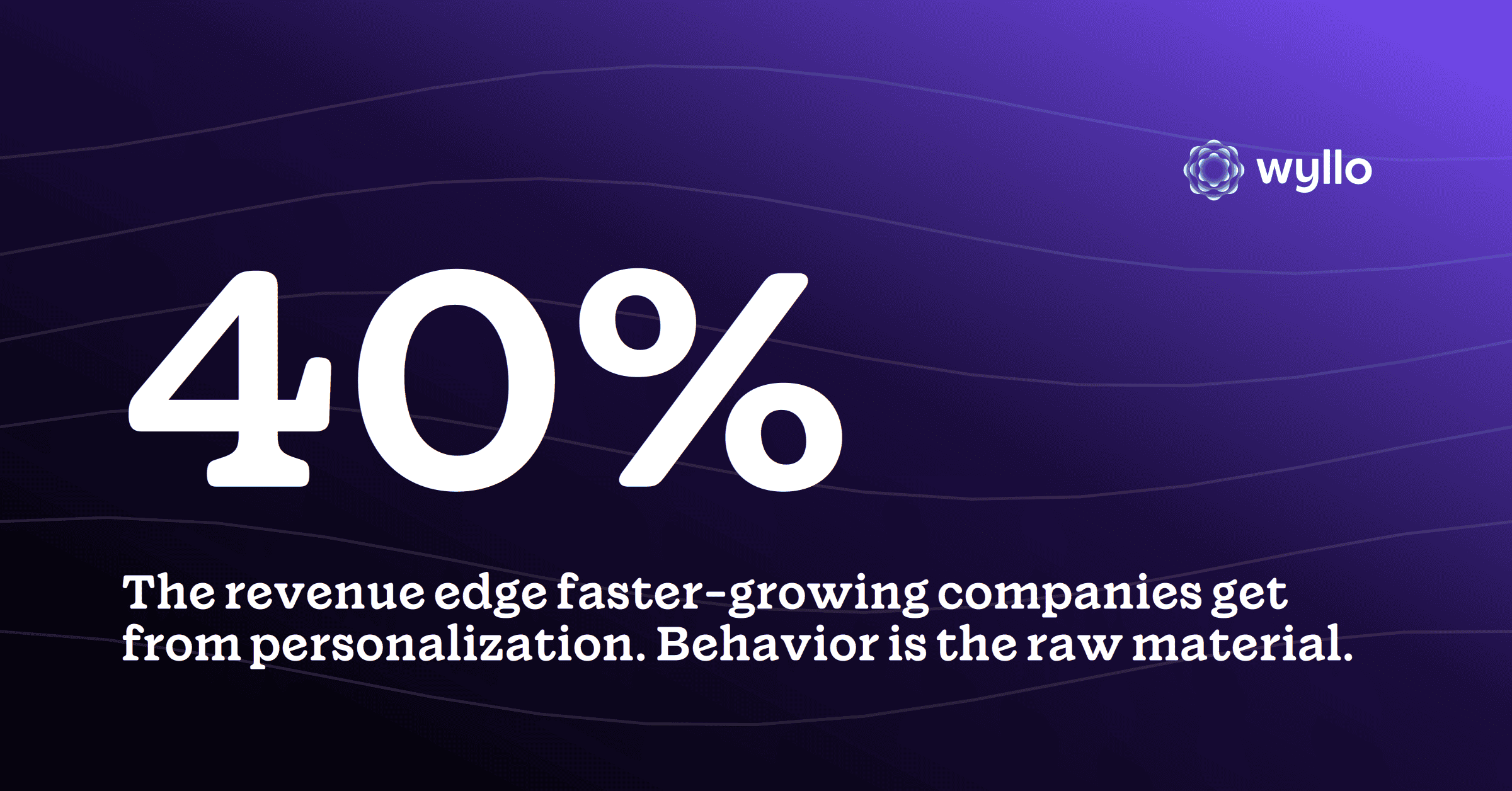
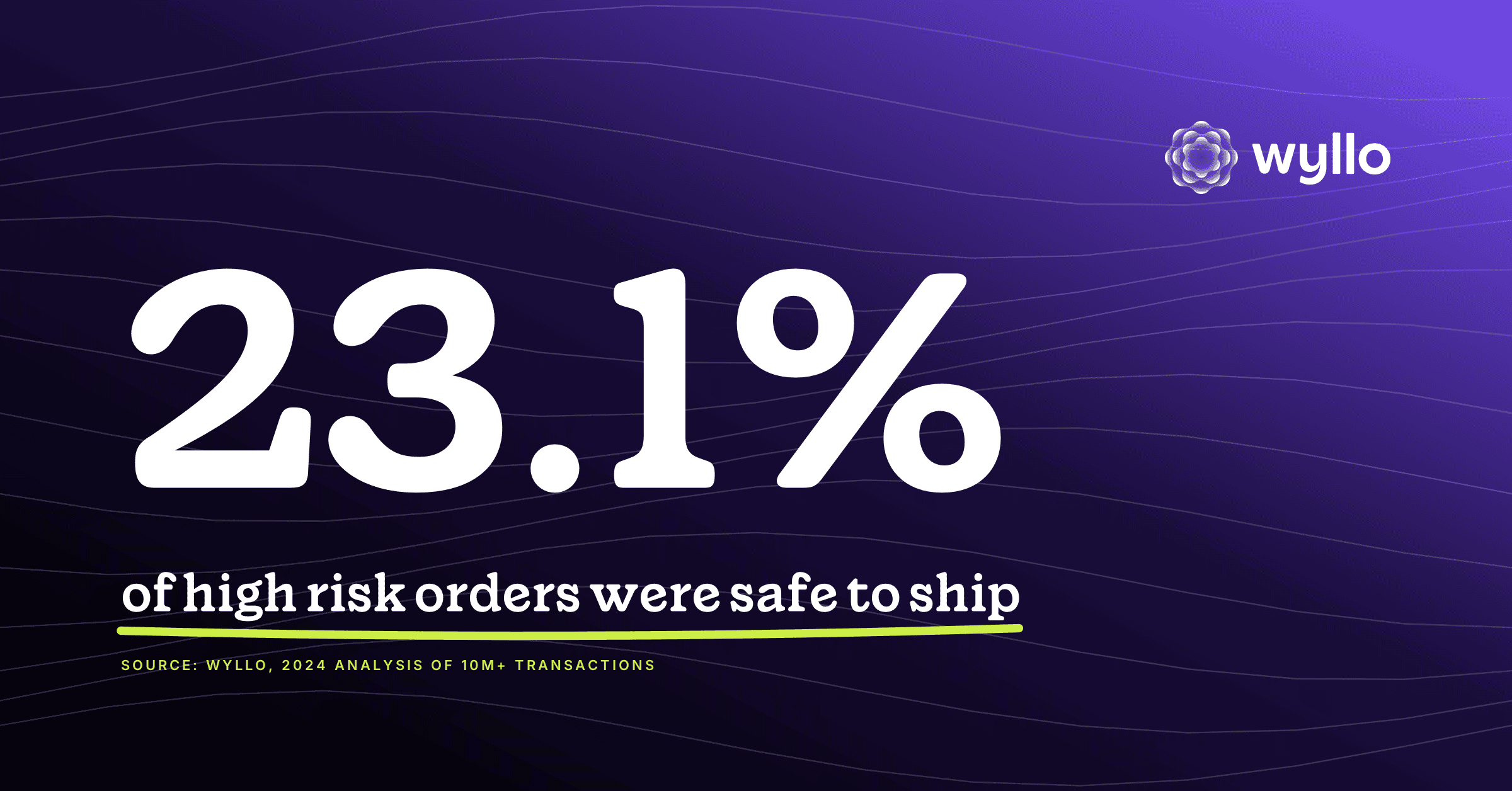
Wyllo’s 2024 analysis of more than 10 million ecommerce transactions that passed through both Shopify’s fraud tool and Wyllo put a number on it. Of the orders Shopify classified as high risk, 23.1% were safe enough that Wyllo approved them and backed them with a chargeback guarantee. Of the orders Shopify classified as medium risk, roughly 80% were safe to ship. In apparel and accessories, taking both flag types together, 60% of the orders Shopify suggested canceling or confirming were good business.
This guide covers what Shopify’s fraud analysis actually measures, the order types it does not reach, what those flagged orders are worth, and how adding Wyllo Payment Fraud Protection changes the outcome. For the mechanics of why fraud tools misfire in general, our companion piece on false positives in fraud detection goes deeper.
How Shopify’s Fraud Analysis Works
Shopify evaluates eligible orders and surfaces an “Order risk” section with a recommendation. The guidance reads as one of three things: you can fulfill this order, confirm with the customer before fulfilling, or consider canceling this order. Medium and high risk orders carry a warning symbol in the Orders list.
Per Shopify’s own documentation, the recommendations are “powered by machine learning algorithms that are trained on historical transactions across all Shopify stores.” The indicators it weighs include whether the Address Verification System passed, whether the customer supplied the correct CVV, whether the customer’s location matches the payment method, unusual device or network activity, and whether the customer tried more than one credit card.
That phrase about training data is the whole story. A model trained across all Shopify stores learns an average normal. Your store is not the average. A $400 order is routine at a furniture brand and alarming at a commodity retailer. Twelve units to one address is a red flag for a grocer and an ordinary restock for a trade supplier. The further your customers sit from the platform mean, the more often a generic model will mistake your best buyers for risk.
Automation is available through Shopify Flow, which can capture payment on low risk orders, hold high risk orders for manual review, or cancel and restock orders matching your criteria. Worth noting for anyone who built their setup years ago: the old Fraud Filter app no longer appears anywhere in Shopify’s current documentation, so if your store still leans on it, see why Shopify Fraud Filter is gone and what replaces it. For the rules worth running alongside Shopify’s analysis, we cover 8 advanced rules every Shopify merchant should set up.
Shopify is clear about the limits of the output. Its documentation notes that “individual indicators and group headings don’t represent the order’s overall risk level,” and that an IP address or location description by itself is not a fraud recommendation. It is also explicit about who carries the loss: “Shopify doesn’t cover charge reversals from banks.” The decision to reverse funds sits with the issuing bank, not the platform.
What You Get Depends on Your Plan
Fraud indicators are available on the Basic plan or higher. Fraud recommendations, the part that actually tells you what to do, require the Grow plan or higher, or that you use Shopify Payments. Merchants on a third-party gateway below Grow see signals without a verdict, and Shopify advises checking with that gateway about its own analysis limitations.
Shopify Protect sits alongside this as free chargeback protection on eligible orders. Eligibility is scoped by region and payment setup, so confirm directly with Shopify whether your store qualifies rather than assuming it applies.
Where Shopify’s Fraud Analysis Stops
The tool is scoped to online credit card orders Shopify can verify. By Shopify’s documentation, it returns no recommendation on several order types, among them test orders, free orders, orders paid in full with a gift card, point of sale orders, and subscription renewals.
Read that list against a modern commerce business. Subscription renewals are where first-party disputes concentrate. Gift card redemption is a known laundering path. Point of sale is where in person and online risk meet. These are not edge cases; for many merchants they are growing fastest, and they sit outside the screen entirely.
The other structural gap is time. Shopify’s analysis is a checkout event. It sees the order in front of it and the signals available in that session. It does not watch what happens afterward, so the return that arrives three weeks later, the claim that the box was empty, the refund request from an account linked by device to four prior claims, all of it lands outside the frame. Our guide to post-purchase fraud covers that territory.
How many flagged orders are actually safe to ship?
This is where the numbers matter. The table below reflects Wyllo’s 2024 analysis of orders that Shopify flagged and Wyllo subsequently approved, broken out by vertical. The left column covers orders where Shopify advised confirming with the customer first. The right column covers orders where Shopify advised cancellation.
| Industry | Confirm first, safe to ship | Consider canceling, safe to ship |
|---|---|---|
| Animal and pet supplies | 67.5% | 10.8% |
| Apparel | 80.4% | 18.8% |
| Appliances | 90.5% | Not available |
| Audio equipment | 20.0% | 20.0% |
| Auto parts | 75.1% | 27.0% |
| Cosmetics | 80.7% | 42.6% |
| Eyewear | 81.7% | 16.9% |
| Footwear | 78.6% | 20.0% |
| Furniture | 88.7% | 39.4% |
| Nutritional supplements | 86.5% | 19.3% |
| Smoke and vape | 64.6% | 16.4% |
| Sporting goods | 83.6% | 36.7% |
| Toys | 84.0% | 23.9% |
| Wigs and extensions | 81.9% | 30.2% |
| Wine and spirits | 95.1% | 27.2% |
Three things stand out. First, the spread is enormous: 20% of flagged audio equipment orders were safe versus 95.1% in wine and spirits. A single platform wide model will struggle to serve both well. Second, even in the cancel bucket, the category Shopify treats as most dangerous, cosmetics merchants were turning away good orders 42.6% of the time. Third, the categories Shopify flags most aggressively are not the low value ones, which is where a wrong call costs most.
These figures come from 2024 and reflect that period’s transaction mix and Shopify model behavior. Treat them as directional evidence that platform level risk scoring is blunt, not as a current guarantee of what your own store would see.
What Declining Good Customers Actually Costs
The orders in that table are not abstractions. They are customers who tried to pay you.
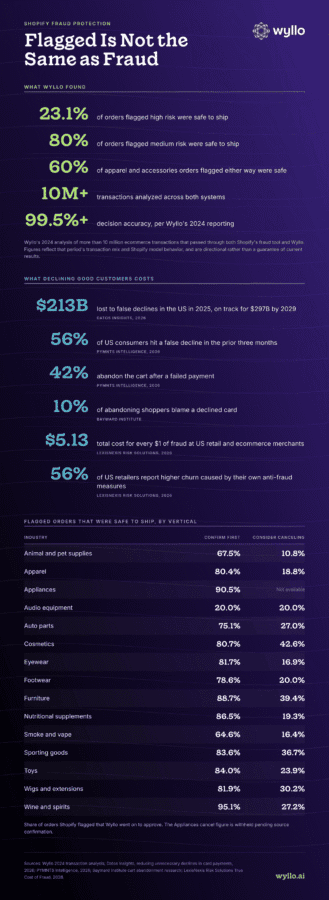
Datos Insights’ May 2026 report on unnecessary declines puts US false declines at $213 billion a year as of 2025, on track for $297 billion by 2029. Merchant side tools layer their own declines on top of that, and a good customer can be turned away at either point.
Customers notice and they do not come back quietly. PYMNTS Intelligence data published in September 2026 found 56% of US consumers had experienced a false payment decline in the prior three months, and 42% abandon their carts after a failed payment. Baymard Institute’s checkout research lists a declined card as the reason 10% of abandoning shoppers gave for leaving.
The second order cost is larger than the lost order. LexisNexis Risk Solutions’ 2026 True Cost of Fraud Study found every dollar lost to fraud costs US retail and ecommerce merchants about $5.13 once investigation and recovery are counted. The same study found 56% of US retailers report increased customer churn tied to their own anti-fraud measures, and organizations with mature fraud programs were more than twice as likely to report decreased churn. Tightening is not free, and loosening blindly is not the answer either.
Shopify Fraud Analysis and Wyllo, Side by Side
| Shopify fraud analysis alone | Shopify with Wyllo | |
|---|---|---|
| What it produces | A low, medium, or high risk recommendation | An approve or decline decision you can act on automatically |
| What it is trained on | Historical transactions across all Shopify stores | Network signals plus your store’s own customers, order mix, and history |
| Who carries the chargeback | You. Shopify states it does not cover bank reversals | Optional chargeback guarantee on approved orders |
| Order types reached | Online credit card orders Shopify can verify | Adds subscription renewals, gift card and post-purchase activity |
| What happens after checkout | Analysis ends at the order | Returns, claims, support contacts and disputes inform the same customer view |
| Gray area orders | Left to the merchant to confirm manually | Reviewed by human fraud analysts with full customer context |
| What it is accountable for | A risk signal; the merchant carries the outcome | An approval decision backed by an optional chargeback guarantee, at 99.5% or higher accuracy per Wyllo’s 2024 reporting |
The point is not a knock on Shopify’s tool. It is that a platform level model and a merchant level decision engine are different products solving different problems. Shopify tells you an order looks unusual compared with every other Shopify store. Wyllo tells you whether this particular customer, at your particular store, is worth approving, and then stands behind the answer.
How Wyllo Helps
Wyllo, the risk intelligence platform for commerce, installs alongside Shopify’s native analysis rather than replacing your checkout. The signals Shopify surfaces become one input among many, and the decision gets made with the context Shopify cannot see: your repeat customers, your returns history, your claim patterns, and coordinated abuse across linked accounts.
- Wyllo Payment Fraud Protection screens transactions with AI decisioning plus human fraud analysts, so clear cases resolve in real time and the gray zone gets judgment instead of a default decline. An optional chargeback guarantee turns residual risk into a predictable line item.
- Wyllo Return Fraud and Abuse Prevention extends the view past checkout to the returns and refunds Shopify’s analysis never sees.
- Wyllo Claim and Policy Abuse Prevention catches item not received claims, policy exploitation and first-party misuse before they become chargebacks.
- Wyllo CX Support puts risk context inside your support tools, so an agent handling a held order can resolve it with the full picture.
The result is precision over paranoia.
Frequently Asked Questions
What is Shopify fraud analysis?
Shopify fraud analysis is a built-in feature that evaluates eligible online credit card orders and returns a recommendation of low, medium, or high risk, alongside indicators such as AVS and CVV results, location match, and unusual device activity. Per Shopify’s documentation, the recommendations are produced by machine learning trained on historical transactions across all Shopify stores. It advises; it does not decide, and it does not carry chargeback liability.
Is Shopify’s fraud analysis accurate enough on its own?
Shopify publishes no accuracy rate for the tool. What the available evidence shows is that it flags a substantial share of legitimate orders, because a model trained on platform wide averages cannot account for what is normal at your store specifically. Wyllo’s 2024 analysis found 23.1% of Shopify’s high risk orders and roughly 80% of its medium risk orders were safe to ship.
Does Shopify cover chargebacks on orders it marks low risk?
No. Shopify’s documentation states plainly that it does not cover charge reversals from banks, and that the decision to reverse funds is made by the issuing bank rather than by Shopify. Shopify Protect provides free chargeback protection on eligible orders, but eligibility is scoped by region and payment setup, so confirm with Shopify whether your store and payment method qualify.
Which orders does Shopify’s fraud analysis not evaluate?
By Shopify’s documentation, it returns no recommendation on several order types, among them test orders, free orders, orders paid in full with a gift card, point of sale orders, and subscription renewals. Merchants using some third-party gateways may also see reduced functionality. Those exclusions matter because subscription renewals are where dispute risk concentrates for many merchants.
Do I need the Grow plan to get fraud recommendations?
Fraud indicators are available on Basic or higher, but fraud recommendations require the Grow plan or higher, or that you use Shopify Payments. If you are on a lower plan with a third-party gateway, you see the underlying signals without the verdict, which puts more interpretation on your team.
Can I use Wyllo alongside Shopify’s fraud analysis?
Yes, and that is the intended setup. Wyllo does not replace Shopify’s native analysis. It treats those signals as one input and layers merchant-specific context, cross-channel history and human analyst review on top, producing a decision rather than a recommendation, with an optional guarantee behind it.
Bringing It Together
Shopify gives every merchant a reasonable baseline for free, and that is worth having. The limitation is structural rather than a flaw in execution: a model trained across every Shopify store is calibrated to an average business, it stops at the checkout event, it skips several order types that now carry real risk, and it hands the chargeback back to you regardless of what it recommended.
The merchants getting the most from Shopify are the ones who treat its risk signal as the beginning of a decision rather than the end of one. That means measuring how many flagged orders turn out to be good customers, watching approval rate with the same attention as chargeback rate, and giving borderline orders the context and the human judgment they need instead of a default decline.
Curious how an intent-aware risk intelligence approach would change your Shopify approval rate? Start with Wyllo Payment Fraud Protection for AI plus human analyst decisioning with an optional chargeback guarantee, or explore the broader Wyllo platform for connected intelligence across the full customer journey.